The science behind the cards
Flashcards look simple: a prompt on one side and an answer on the other. Their value does not come from the card itself, however. It comes from what a well-designed card asks your brain to do: retrieve an answer, check it, and return to it after some time has passed.
Used well, flashcards can make vocabulary easier to retain and quicker to recall. Used badly, they become a growing pile of isolated translations that feel familiar inside the deck but disappear during a real conversation.
Do flashcards actually work for language learning?
Yes, particularly for learning and maintaining the connection between a word or phrase and its meaning. Flashcards are most effective when you attempt an answer before revealing it, receive corrective feedback, and spread reviews across multiple sessions.
This combines two well-supported memory principles. Retrieval practice strengthens later retention by making you bring information back to mind. Distributed practice improves long-term recall by separating learning events instead of concentrating them into one cram session.
Research focused specifically on flashcard study has also found that spacing cards across days produces better learning than cramming the same material together. In second-language vocabulary research, retrieval is especially reliable when the learner sees the correct answer after each attempt.
That does not mean flashcards can teach an entire language. They train particular memories. You still need reading, listening, conversation, and writing to recognise words in varied contexts and use them naturally.
A short history of flashcards and spaced repetition
Teachers were using paper cards for reading instruction by the nineteenth century. One early example often credited in histories of the flashcard is Favell Lee Mortimer's 1834 phonics system, Reading Disentangled. The underlying idea was already familiar: show a small prompt, ask the learner to respond, and reveal the answer.
The more recognisable review system arrived much later. In his 1972 book So lernt man lernen, Sebastian Leitner described sorting cards into boxes according to how well they were remembered. Difficult cards returned frequently. Successfully recalled cards moved into boxes reviewed at longer intervals.
That physical box system turned spacing into a practical routine. During the 1980s, Piotr Woźniak began developing algorithms that calculated review intervals, leading to the first computer version of SuperMemo in 1987. Modern flashcard software automates the same broad decision: show weaker memories sooner and stronger memories later.
Why flashcards help words stick
They require retrieval, not another reread
Reading la llave means the key several times can create familiarity. A flashcard that shows la llave and makes you produce the key tests whether the connection is actually available. The pause before turning the card is the useful part.
Say or think the complete answer first. Turning a card over immediately trains recognition of the answer, not retrieval from memory.
They separate reviews over time
A word recalled four times in ten minutes may feel secure because it never had time to become difficult. Seeing it today, tomorrow, several days later, and again next week creates more demanding retrievals. That difficulty is useful when it remains achievable.
A study designed around flashcard use found that spacing was more effective than cramming, even when the overall study time was controlled.
They give immediate corrective feedback
Retrieving the wrong answer without correction can reinforce an error. A useful card reveals the expected answer immediately, allowing you to compare it with what you produced. Research on foreign-language vocabulary has found benefits when retrieval practice is paired with corrective feedback.
They direct effort toward weaker memories
A shuffled paper deck, a Leitner box, or a digital scheduler can all prevent easy words from taking the same amount of attention as difficult ones. The aim is not to review everything equally. It is to spend more effort where recall is still unreliable.
What flashcards can and cannot teach
| Flashcards are useful for | Flashcards cannot replace |
|---|---|
| Connecting a word or phrase with its meaning | Following extended speech at natural speed |
| Practising recall of gender, spelling, or a short phrase | Managing an unpredictable conversation |
| Maintaining words that do not appear often enough | Learning every nuance from a single translation |
| Turning small pockets of time into focused review | Pronunciation feedback from a teacher or speaker |
| Making forgotten vocabulary visible | Encountering words across varied, meaningful contexts |
Knowing a word on a card and producing it while speaking are related but different abilities. If a word matters in conversation, practise using it in sentences, messages, and speech as well as recognising it in a deck.
How to make effective language flashcards
Give each card one clear job
A card should make it obvious what answer you are trying to retrieve. If the back contains five translations, three grammar rules, and an entire paragraph, it becomes difficult to decide whether you knew it. Split overloaded cards into smaller prompts.
Answer before you reveal
Pause long enough to produce a real answer, then turn the card. Be honest when rating the result. A vague feeling that the answer looked familiar is not the same as recalling it.
Add enough context to disambiguate the word
Single-word cards are fast, but translations are rarely perfect matches. A short, natural example can clarify meaning, gender, or usage. Keep the target word prominent and the context concise enough that the sentence does not give the answer away.
Match the direction to your goal
Target-language to meaning cards practise recognition, which helps with reading and listening. Meaning to target-language cards demand production, which is closer to speaking and writing. If both matter, practise both directions—but treat them as separate cards because they are separate retrieval tasks.
Use images and audio when they add information
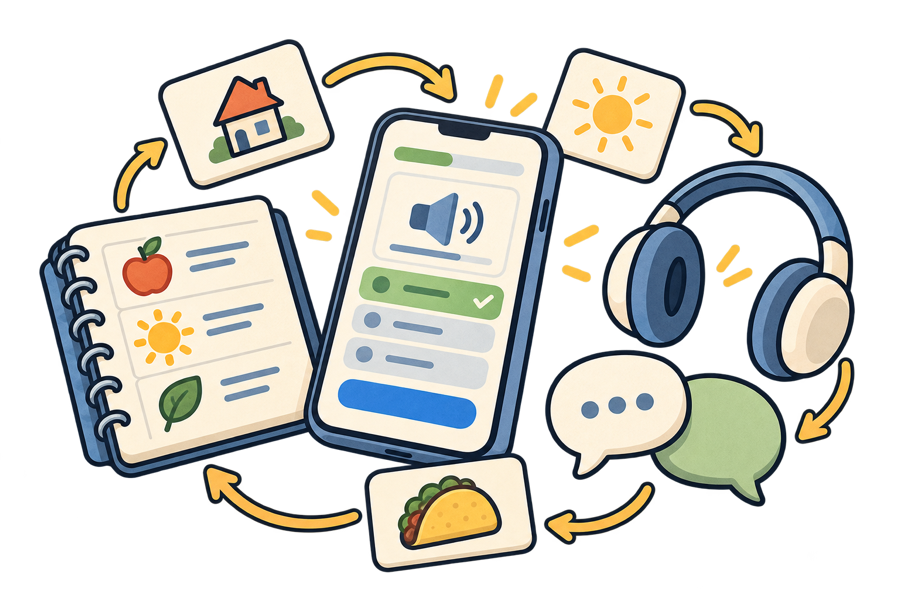
An image can create a direct cue for a concrete noun. Audio can train recognition of a word you may hear but not yet identify. Media should clarify the answer, not decorate every card or make creation so slow that you stop adding useful vocabulary.
Keep the workload sustainable
Every new card creates future reviews. Start with a small number of useful words and increase only when the existing workload feels comfortable. Reformulate, pause, or remove cards that remain confusing because of a bad prompt.
Examples of useful language flashcards
| Card type | Front | Back |
|---|---|---|
| Recognition | la llave | the key |
| Production | the key | la llave |
| Sentence gap | No encuentro la ___. | llave |
| Listening | Audio of la llave | la llave · the key |
The best format depends on what you want to do with the word. A learner who mainly wants to read may prioritise recognition. Someone preparing to speak about a particular topic should include more production and sentence-level prompts.
Paper flashcards or a spaced repetition app?
Paper cards are inexpensive, distraction-free, and easy to arrange physically. A simple Leitner box can create spaced review without software: remembered cards move forward and forgotten cards return to the first compartment.
Digital flashcards are easier to carry, search, duplicate, and enrich with audio or images. They can also calculate review dates automatically. The trade-off is that sophisticated settings can become a hobby of their own. The best format is the one that keeps you retrieving useful language consistently.
Two flashcard tools for language learners
VocabTally
VocabTally is designed around Spanish vocabulary. You can collect words encountered in lessons, books, videos, and conversations, practise with flashcards and quizzes, create custom decks, and see your vocabulary progress. It suits learners who want their word log, practice, and progress in one focused place.
Anki
Anki is a general-purpose flashcard program with extensive control over card layouts, media, decks, and review scheduling. It suits learners who want to customise their system deeply or manage a large collection. That flexibility also means there is more to configure.
Neither tool is automatically better for every learner. Choose the level of control you will actually use. For a closer comparison, read VocabTally vs Anki.
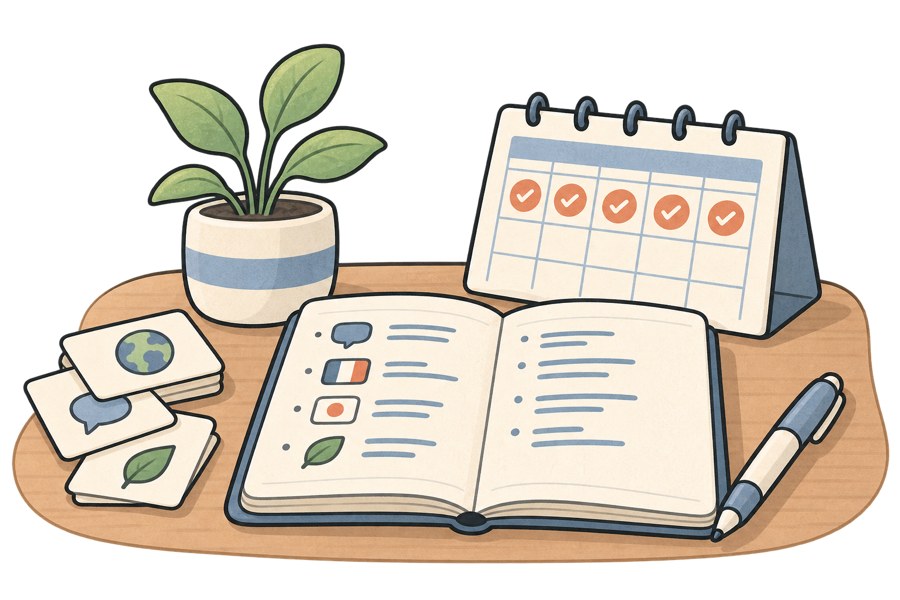
A simple flashcard routine
- Collect a few useful words from something you read, watched, heard, or tried to say.
- Create one clear prompt for each retrieval task.
- Review for five to ten focused minutes, answering before revealing.
- Use one or two reviewed words in a sentence, message, or conversation.
- Fix cards that are ambiguous and remove cards that no longer serve a purpose.
This keeps the deck connected to the language you are actually encountering. The cards help preserve useful material; real input and output teach you how that material behaves.
Frequently asked questions
Are flashcards good for learning a language?
Yes. They are particularly useful for deliberate vocabulary learning and retention when you practise retrieval, check the answer, and space reviews over time. They work best as one part of a wider routine.
Should the foreign word or the English meaning go first?
Put the foreign word first when you want to practise recognition for reading or listening. Put the meaning or situation first when you want to practise producing the foreign word. Use both directions if both skills matter.
Do I need spaced repetition software?
No. Paper cards and a Leitner box can create spaced review. Software is useful because it carries the deck, records your answers, and schedules future reviews automatically.
How many new flashcards should I add each day?
Begin with a small number that does not make tomorrow's review feel burdensome. The right amount depends on your available time, the difficulty of the language, and how complex your cards are. Consistency matters more than an ambitious daily target.
Why can I remember a word on a card but not in conversation?
The card provides a familiar cue, while conversation requires you to choose and produce language under different conditions. Add production cards, use words in your own sentences, and practise speaking and writing so retrieval becomes flexible.
Use flashcards as a bridge to real language
Flashcards work because they turn remembering into an action and return before a memory disappears completely. Their job is not to replace Spanish books, videos, lessons, or people. Their job is to help useful language survive long enough for you to meet it again—and eventually use it without the card.
VocabTally is not affiliated with or endorsed by Anki. Anki is a trademark of Ankitects Pty Ltd.
Updated