VocabTally vs a Spreadsheet or Notion Vocab List at a glance
| What you need | VocabTally | Google Sheets / Notion |
|---|---|---|
| Saving vocabulary | A dedicated personal word collection | Flexible rows or database entries |
| Custom notes and structure | A focused vocabulary workflow | Choose your own fields, relations and layouts |
| Recall practice | Built-in flashcards and quizzes | Hide columns, build a template or add another tool |
| Spaced repetition | Built-in spaced review | Set up dates, formulas, reminders or an integration |
| Progress view | Vocabulary totals and learning statistics | Counts and charts are possible with setup |
| Maintenance | The app handles its study interface | You maintain the list and any review logic |
Who a spreadsheet or Notion vocab list is best for
A spreadsheet is an excellent place to begin. You can keep a Spanish word, translation, example sentence and source together, sort them however you like and adapt the structure immediately. Notion adds flexible pages and databases if you prefer a richer study notebook. If your vocabulary lives beside class notes, keeping everything in one place may matter more than having a separate practice app.
These tools also suit people who enjoy building their own systems. Google Sheets can count and chart entries, while Notion supports database formulas and chart views. It would be unfair to say they cannot show progress or support review: they can, with a workflow you create or a suitable template.
Where a plain list starts to break down
A two-column list stores information, but it does not itself ask you to recall a word, decide which items should return today or distinguish a familiar entry from one you keep forgetting. Opening the same rows can become rereading rather than testing yourself. You may have hundreds of entries and still find it hard to choose what to practise in a short break.
You can solve that by hiding a translation column, adding review dates and making charts. The tradeoff is maintenance: every extra field and formula becomes part of the system you must keep working. The issue is not a lack of capability in Sheets or Notion; it is whether you want to build and manage those capabilities for vocabulary.
Who VocabTally is best for
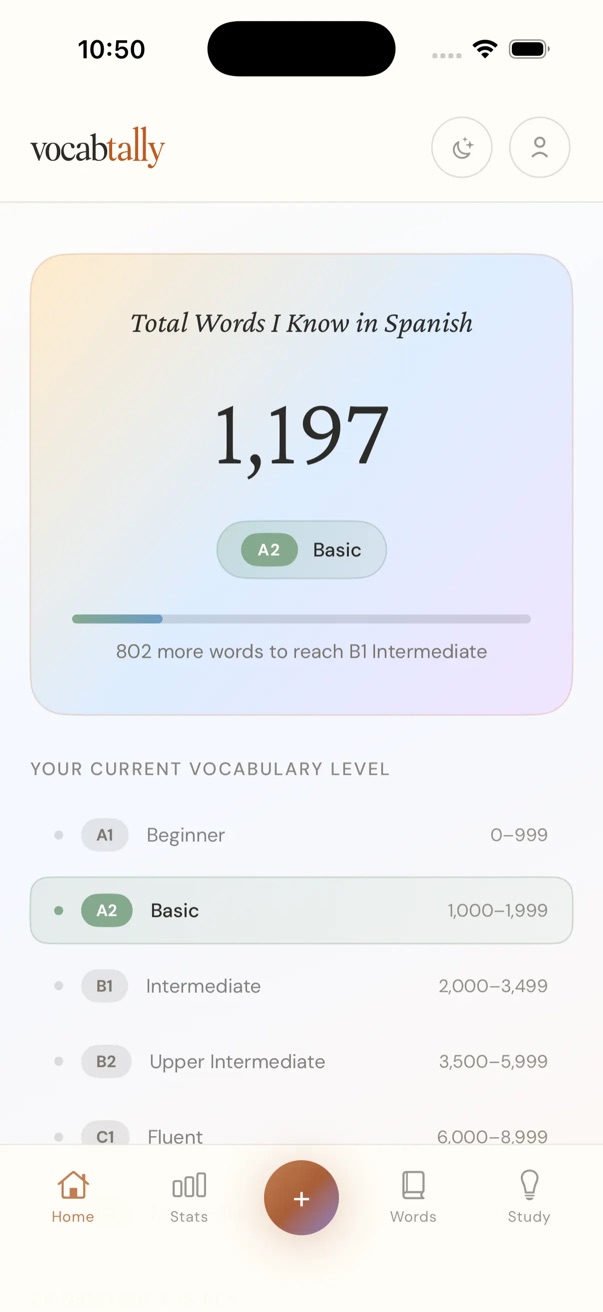
VocabTally suits learners who want to spend that time on words. Add the Spanish vocabulary you understand, see your total and return for flashcards or quizzes. Spaced review gives previously learned material a place in your routine, instead of leaving it buried below the newest rows.
Suppose your list contains words from a Spanish cooking class, a novel and your next trip. In VocabTally, those words become part of one personal collection, and you can group saved vocabulary into custom flashcard decks. Keep your detailed class notes elsewhere if they help; the tracker can take over the collecting, counting and practising part of the routine.
Moving from a list to a learning habit
Start with a small set of words you genuinely recognise, rather than treating every row you once saved as mastered. Add them to VocabTally, practise a few, then grow the collection as you encounter more Spanish. This is a manual workflow: do not assume there is a one-click Google Sheets or Notion import.
Explore all VocabTally features, check the current plans or start with a Spanish topic guide. If you prefer a dedicated flashcard system with extensive customisation, the Anki comparison explains that choice.
FAQ
Can I use Google Sheets for Spanish vocabulary?
Yes. It is useful for flexible lists, notes, sorting and custom charts; recall practice and review scheduling require a workflow you set up.
Can Notion do spaced repetition?
You can build or use a template with review dates and formulas, or connect another tool. A plain vocabulary database does not automatically provide a complete recall and spaced-review workflow.
Does VocabTally import a spreadsheet or Notion database?
This guide does not offer an automatic import. Start by adding the words you want to keep and practise.
Does a vocabulary count prove I know every word?
No. A count records the words you have added as known; use recall practice and real Spanish to check how comfortably you understand and use them.
Updated